Torah Scroll Layout Standards from Halachah
Textual layout standards for Torah Scrolls come from both Halachah/Jewish Law and Community Conventions. For clarity, a Torah Scroll is defined as one physical scroll containing the text of the Pentateuch – Genesis/Bereshit, Exodus/Shemot, Leviticus/Vayikra, Numbers/Bamidbar, and Deuteronomy/Devarim. The Torah itself references the Sefer Torah – in Deuteronomy 31:26.
לָקֹחַ אֵת סֵפֶר הַתּוֹרָה הַזֶּה וְשַׂמְתֶּם אֹתוֹ מִצַּד אֲרוֹן בְּרִית-יְהוָה אֱלֹהֵיכֶם וְהָיָה-שָׁם בְּךָ לְעֵד
Historical references to Torah Scrolls emerge after the destruction of the 2nd Temple in 70 C.E. During this period, the role of the Synagogue expanded greatly, and the scribal community assigned a high level of sanctity to the text and to the integrity of the copying process.
Halachic layout specifications assist us in Torah Scroll Navigation, since every Torah Scroll must adhere to them to be kosher for liturgical use in public reading. These specifications result in certain Columns having formatting so unique and distinctive, that even a non-Hebrew reader can recognize the Column, creating Anchor Columns. Experienced Torah Readers, who can easily find a specific Parashah, instinctively use these Anchor Columns to locate their text. The approach of Torah Scroll Navigation books, such as the “Torah Scroll Column Reference Guide” and the “Torah Scroll Column Locator Handbook" use these standards to create repeatable processes to help any individual with basic Hebrew reading skills locate an Aliyah.
These standards have survived the diaspora and the centuries. Halachah defines Torah Scroll layout standards related to:
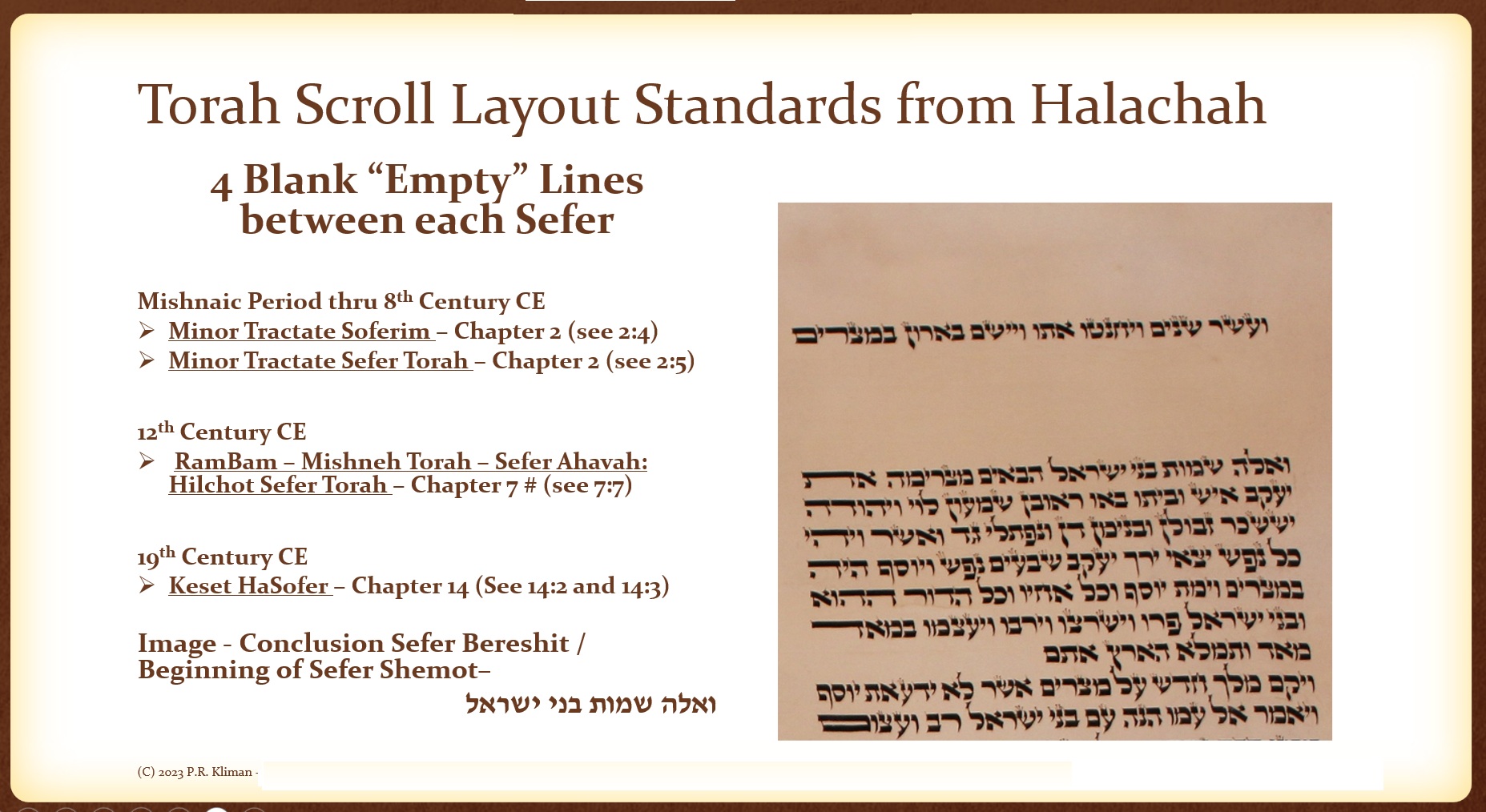
- 4 blank lines between each of the books of the Torah
Minor Tractate Soferim – Chapter 2 (see 2:4)
Minor Tractate Sefer Torah – Chapter 2 (see 2:5)
Mishneh Torah/Sefer Ahavah/Hilchot Sefer Torah–Chapter 7 (see 7:7)
Keset HaSofer – Chapter 14 (See 14:2 and 14:3)
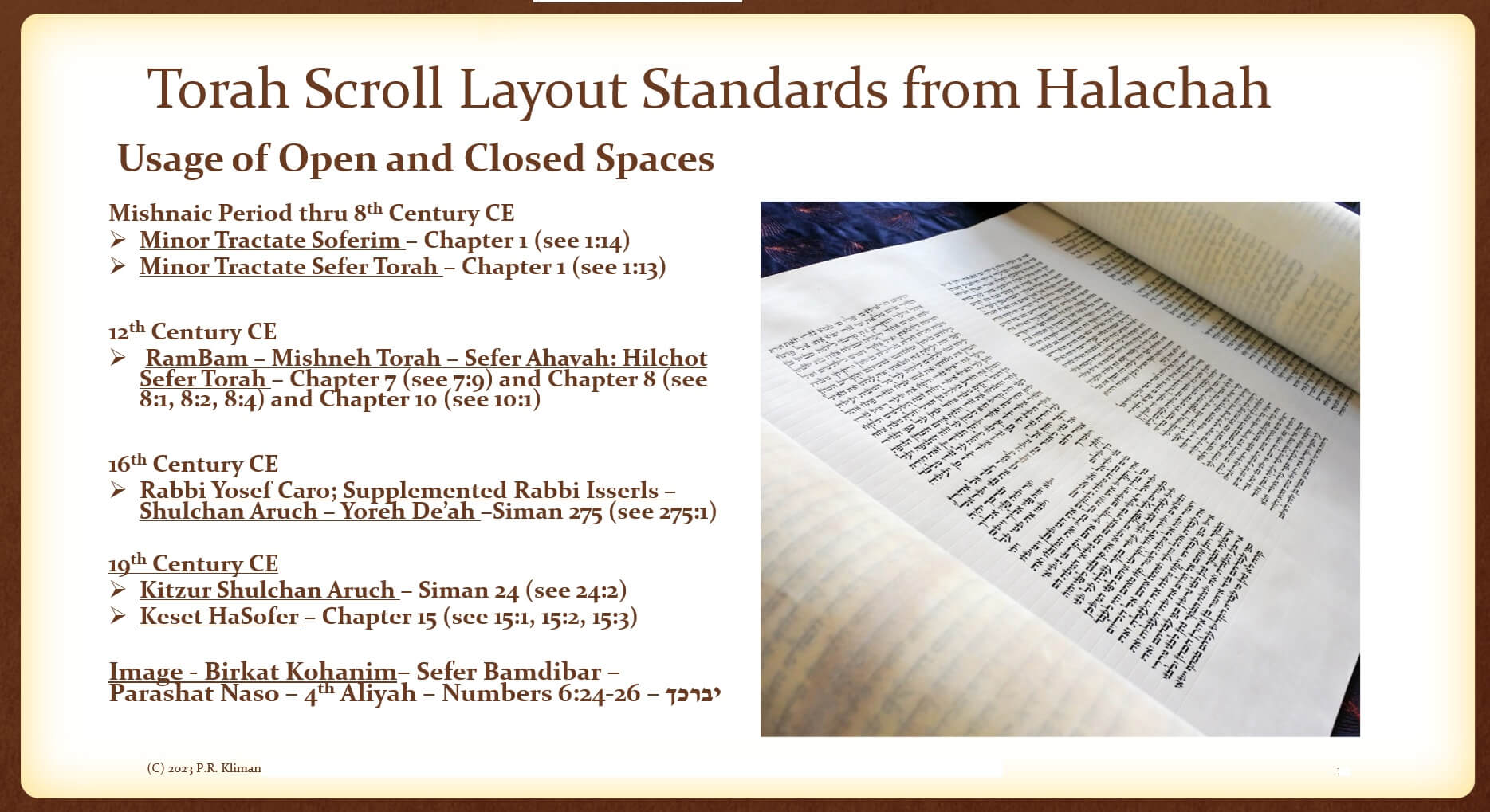
Usage of פתוחה P’tuchah (Open) Spaces and סתומה S’tumah (Closed) Spaces
Minor Tractate Soferim – Chapter 1 (see 1:14)
Minor Tractate Sefer Torah – Chapter 1 (see 1:13)
Mishneh Torah / Sefer Ahavah / Hilchot Sefer Torah – Chapter 7 (see 7:9)
Mishneh Torah / Sefer Ahavah / Hilchot Sefer Torah – Chapter 8 (see 8:1 and 8:2 and 8:4 which contains a complete list of each Open Space and each Closed Space in Sefer Bereshit, Sefer Shemot, Sefer Vayikra, Sefer Bamidbar, and Sefer Devarim)
Mishneh Torah / Sefer Ahavah / Hilchot Sefer Torah – Chapter 10 – (see 10:1 – Requirements for a Torah Scroll to be kosher for public reading – Requirement (q) states that the form of the passages was not altered – refers to not using an Open Space where a Closed Space is required, and not using a Closed Space where an Open Space is required)
Shulchan Aruch – Yoreh De’ah – Siman 275 (see 275:1)
Kitzur Shulchan Aruch – Siman 24 (see 24:2)
Keset HaSofer – Chapter 15 (see 15:1, 15:2, 15:3)
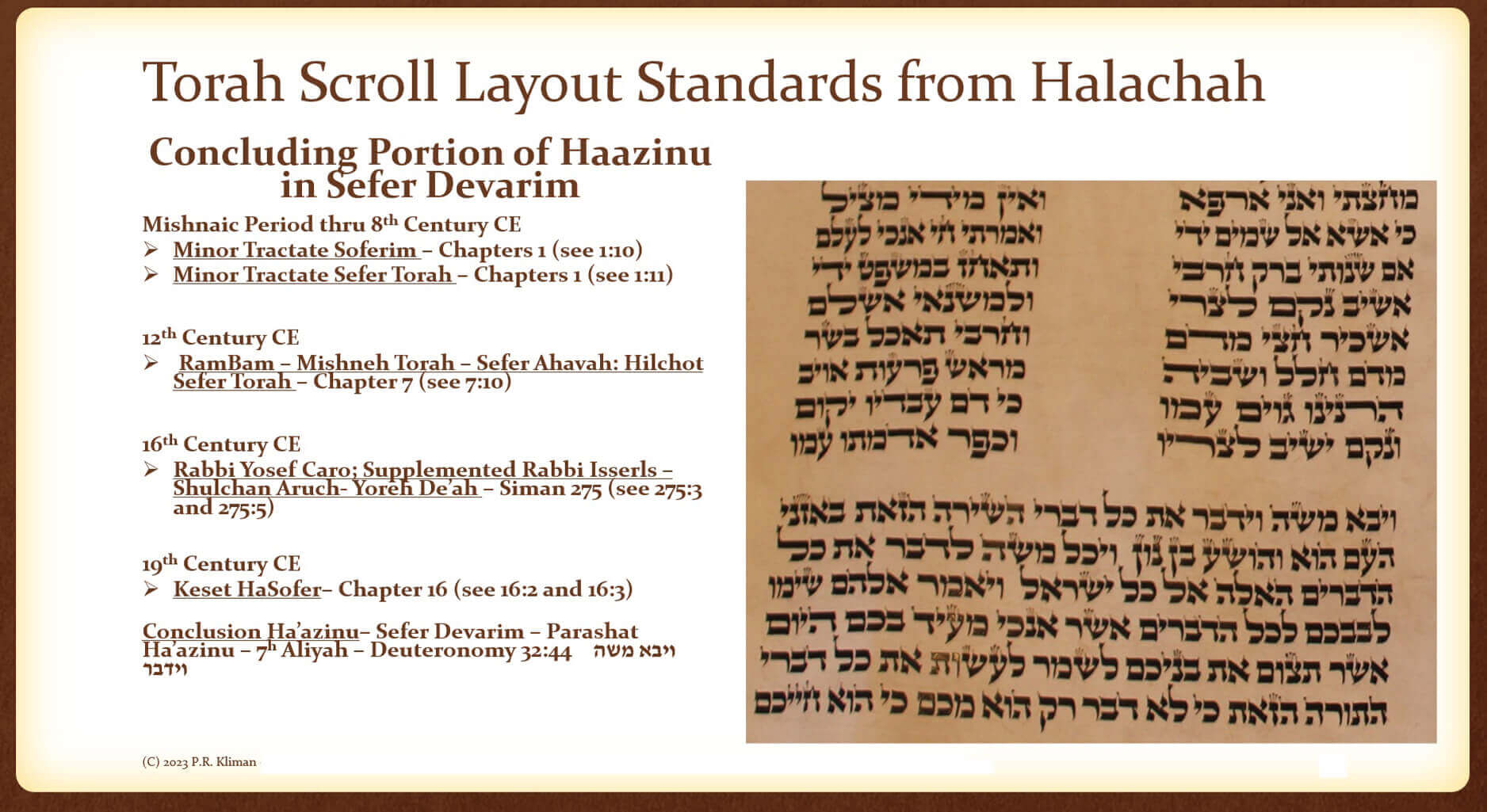
- Format for the song Ha’azinu – Written with S’tumah appearing as Two Columns
Minor Tractate Soferim – Chapters 1 (see 1:10)
Minor Tractate Sefer Torah – Chapter 1 (see 1:11)
Rambam Mishneh Torah – Sefer Ahavah / Hilchot Sefer Torah – Chapter 7 (see 7:10)
Shulchan Aruch – Yoreh De’ah – Siman 275 (see 275:3 and 275:5)
Keset HaSofer – Chapter 16 (see 16:2 and 16:3)
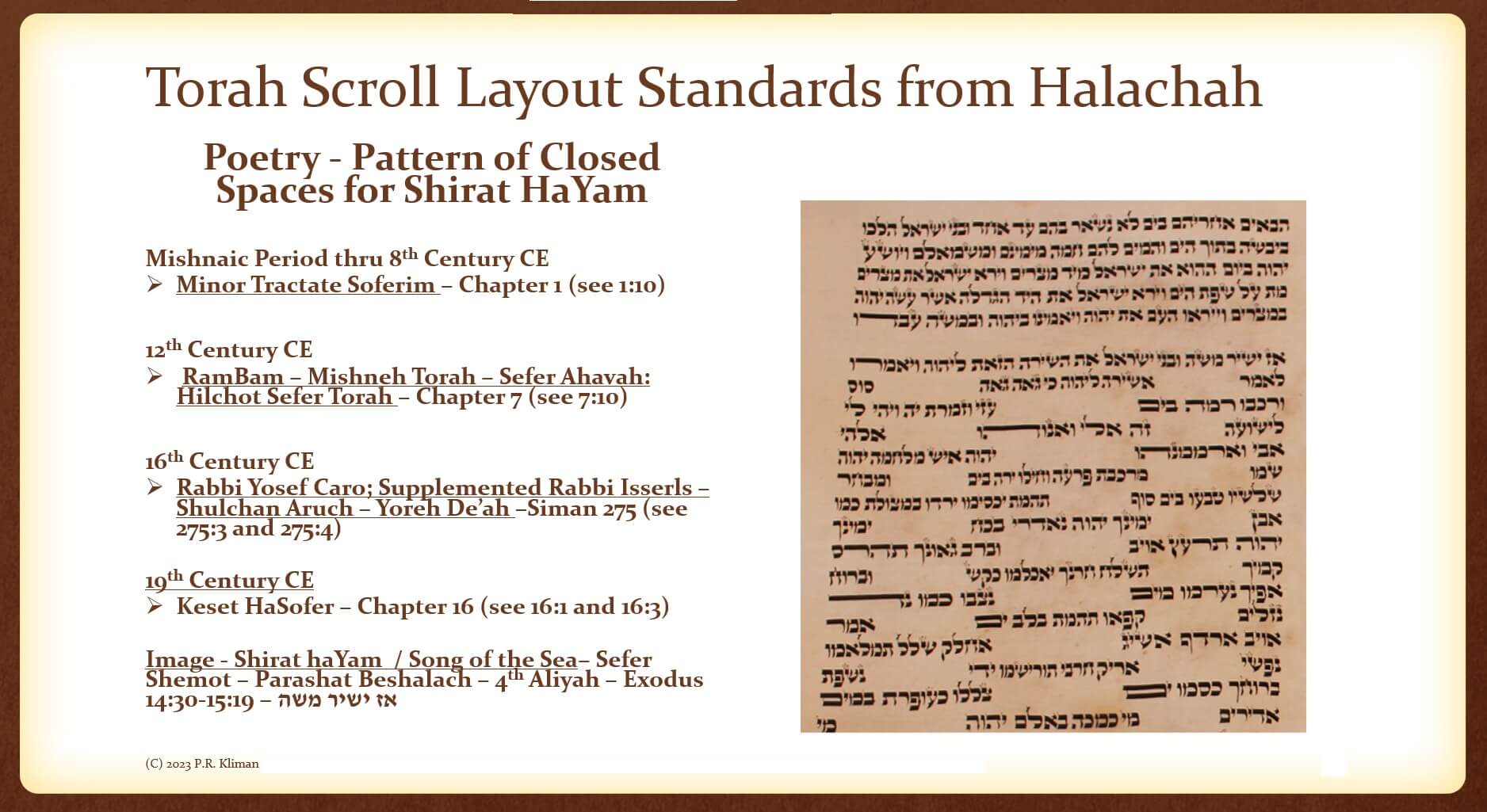
- Format for the Song of the Sea - שירת הים
Minor Tractate Soferim – Chapter 1 (see 1:10)
Rambam Mishneh Torah / Sefer Ahavah / Hilchot Sefer Torah – Chapter 7 (see 7:10)
Shulchan Aruch – Yoreh De’ah – Siman 275 (see 275:3 and 275:4)
Keset HaSofer – Chapter 16 (see 16:1 and 16:3)
Torah Scroll Layout Standards from Community Conventions
The precise layout standards mandated by Halachah/Jewish Law can be followed, while accommodating varying, valid traditions among communities of Jews, stemming from differences developed throughout the Diaspora. These areas include:
- Number of Columns (Amudim)
- Number of Lines per Column
- Whether or not most columns begin with the Hebrew letter Vav
When a combination of a specific number of columns paired with a specific number of lines per column is in frequent use, one or more Tikkun Kor’im are published for that layout standard.
Torah Scrolls in the Yemenite tradition contain 226 columns and 51 lines per column, as did the Torah Scroll that the Rambam wrote. Pre-Shoah European Torah Scrolls have varying numbers of lines per column. Post World War II, Rabbi Menachem Davidovich, zt”l, published a Tikkun that became a standard for the 245 Column / 42 Line layout, with many modern Tikkun Kor’im following this format. Modern Torah Scrolls also contain 248 Columns / 42 Lines.